
Engineering Culture as an Advantage
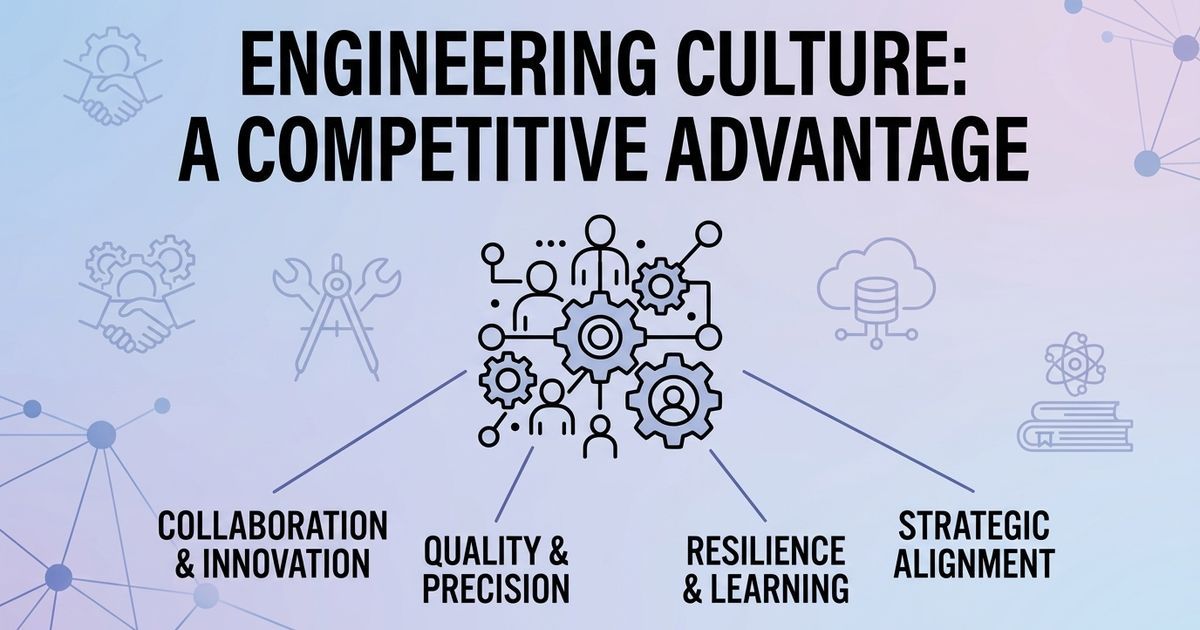

Why Engineering Culture Is a Competitive Advantage, Not Just a Cost Center
Most leadership teams still measure engineering by what it costs. The companies pulling ahead measure it by what it produces — and the gap between the two groups is now wide enough to show up directly in revenue growth.
Want your engineering org measured the right way?
Ask most executives how they think about engineering, and the answer reveals itself in the language used: headcount, burn rate, budget overrun. Engineering is treated as a cost to be managed rather than a capability to be invested in. That framing made sense when software was a back-office function. It doesn't hold up anymore, because in most industries today, the product is the software, and the speed at which your engineering org can build, ship, and improve it is functioning as a direct lever on revenue.
The uncomfortable truth for leadership teams still running on the cost-center mental model: the data increasingly shows that engineering culture — not tooling, not budget size — is the biggest predictor of whether that lever gets pulled or not.
"Culture and structure matter more than tools. You can't buy your way to better developer experience." — Findings from research covering 800+ engineering organizations and 40,000+ developers, DX
The Revenue Case, Not Just the Retention Case
For years, the argument for investing in engineering culture was framed around retention — happier engineers stay longer, so you save on hiring costs. That argument is true but incomplete, and it undersells the actual stakes.
The stronger case is about revenue growth. Companies in the top quartile of developer velocity outperform bottom-quartile peers by as much as five times in revenue growth. That is not a rounding error or a soft "employee satisfaction" metric — it's a structural difference in how fast an organization can turn ideas into shipped, revenue-generating product.
The mechanism is straightforward once you see it: engineering culture determines how much friction exists between an idea and its execution. Teams with strong collaboration, clear decision-making, and psychological safety spend their time solving customer problems. Teams without it spend disproportionate time navigating unclear priorities, waiting on approvals, and re-doing work that wasn't specified correctly the first time. Multiply that friction across every feature, every quarter, and the compounding gap between competitors becomes enormous.
Stats That Matter
- Companies in the top quartile of the Developer Velocity Index outperform bottom-quartile peers by up to 5x in revenue growth.
- Top-quartile engineering teams perform 4-5x better across delivery, quality, and speed than bottom-quartile teams.
- Organizations investing in developer experience report ROI in the range of 151%-433%, based on research drawing from over 4 million measurement samples worldwide.
Why This Doesn't Show Up on a Standard Dashboard
If engineering culture drives revenue this directly, why doesn't it appear on financial reporting the way sales pipeline or marketing spend does? Because the effects are diffuse and delayed. A dysfunctional engineering culture doesn't cause a single dramatic failure leadership can point to — it causes a slow accumulation of missed deadlines, quietly declining feature quality, and top performers leaving for less friction elsewhere.
By the time these effects are visible in a P&L, they've usually been building for a year or more, and they're harder to reverse than they were to prevent. This is precisely why engineering culture needs to be treated as a leadership priority rather than something delegated entirely to engineering management — the cost of getting it wrong is a business cost, even though the symptoms show up inside a technical team.
What "Engineering Culture" Actually Means for a Non-Technical Leader
This term can sound abstract to anyone outside engineering, so it's worth being concrete. In practice, strong engineering culture means:
Clear decision-making authority. Engineers know who can make a call and how, rather than escalating every ambiguous decision up a chain that slows delivery.
Psychological safety around mistakes. Teams that punish errors harshly get engineers who hide problems until they become expensive. Teams that treat errors as information get problems surfaced early, when they're cheap to fix.
Protected focus time. Constant context-switching between meetings, interruptions, and shifting priorities is one of the largest hidden productivity killers in engineering organizations, yet it rarely appears as a line item anywhere.
Alignment between engineering and product priorities. When engineering doesn't understand why something matters to the business, work gets built to the letter of a spec rather than to the actual need — creating rework that looks like a technical problem but is really a communication one.
The Talent Dimension Leadership Can't Ignore
Beyond revenue, there's a talent supply problem compounding this issue. The market is projected to face a shortage of well over a million software engineers in the near term, which means retention is no longer a "nice to have" HR metric — it is a competitive necessity. Good engineers increasingly choose employers based on how the work feels day to day, not just compensation. Organizations with poor engineering culture are effectively competing for talent with one hand tied behind their back, regardless of what they're willing to pay.
What Leadership Should Actually Do
This isn't a call to hand engineering leadership a blank check for "culture initiatives." It's a call to treat engineering effectiveness as a measurable, board-level topic, the same way sales pipeline health or customer churn is measured.
Ask for developer experience data, not just delivery dates. Delivery dates tell you what happened. Developer experience metrics tell you why performance varies and where friction is building before it shows up as a missed deadline.
Separate "engineering costs money" from "engineering culture costs money." The former is true and unavoidable. The latter is a choice, and it's usually the more expensive one — bad culture doesn't reduce your engineering spend, it just reduces what you get for it.
Give engineering leadership air cover to protect focus time and decision-making clarity. These changes rarely require budget. They require leadership explicitly valuing them enough to defend them against the daily pressure to add another meeting or another urgent request.
Key Takeaways
- Top-quartile engineering organizations grow revenue up to five times faster than bottom-quartile peers — this is a business metric, not just a technical one.
- Engineering culture problems accumulate silently and don't show up in standard financial reporting until they're expensive and hard to reverse.
- Culture and structural factors — clear decisions, psychological safety, protected focus time — matter more than tooling or budget size in determining engineering effectiveness.
- Retention is now a competitive necessity, not just an HR line item, given the ongoing shortage of skilled engineers.
- Leadership should request developer experience data alongside delivery timelines to catch friction before it becomes a missed deadline.
What to Do Next
If your organization still measures engineering purely by headcount and delivery dates, you're missing the metrics that actually predict revenue growth. Building the right engineering culture and the leadership behaviors that support it is a capability your teams can be trained on.
I work with a trainer who specializes in exactly this: helping engineering and business leadership build the practices that turn engineering into a growth lever rather than a cost center. If this is on your radar for the next quarter, call or contact me and I'll help you get started.